Don't Trim the 2027 CapEx Plan. Re-Sequence It.
A percentage cut leaves you nothing to re-sequence. Build the 2027 CapEx budget bottoms-up, then use a four-tier filter to decide what moves and what can't.
Budget season is arriving in a market that gives every capital committee a reason to flinch. Construction input prices rose 11.2% year over year in September, according to Associated Builders and Contractors' analysis of federal producer price data. ABC called it the largest annual increase in nearly four years. The Fed raised rates in September for the first time since 2023.
So the 2027 plan has to come down. The usual move is to take last year's number, apply a haircut, and spread it across every line.
That move feels disciplined. Mostly it's a sign the budget was never built in a way that allows anything else.
A percentage roll-forward leaves you nothing to re-sequence
Most multifamily capital budgets aren't built from the buildings up. They're rolled forward: last year's plan, plus or minus a percentage, adjusted for whatever came up during the year.
That's a reasonable shortcut in a quiet year. In a year like this one it's a trap. When the total has to shrink, a top-down budget gives the team only one lever, the total. There's no detail underneath to show which dollars keep a sprinkler system working and which are paying for work that could wait a year. So the team cuts and hopes it works out.
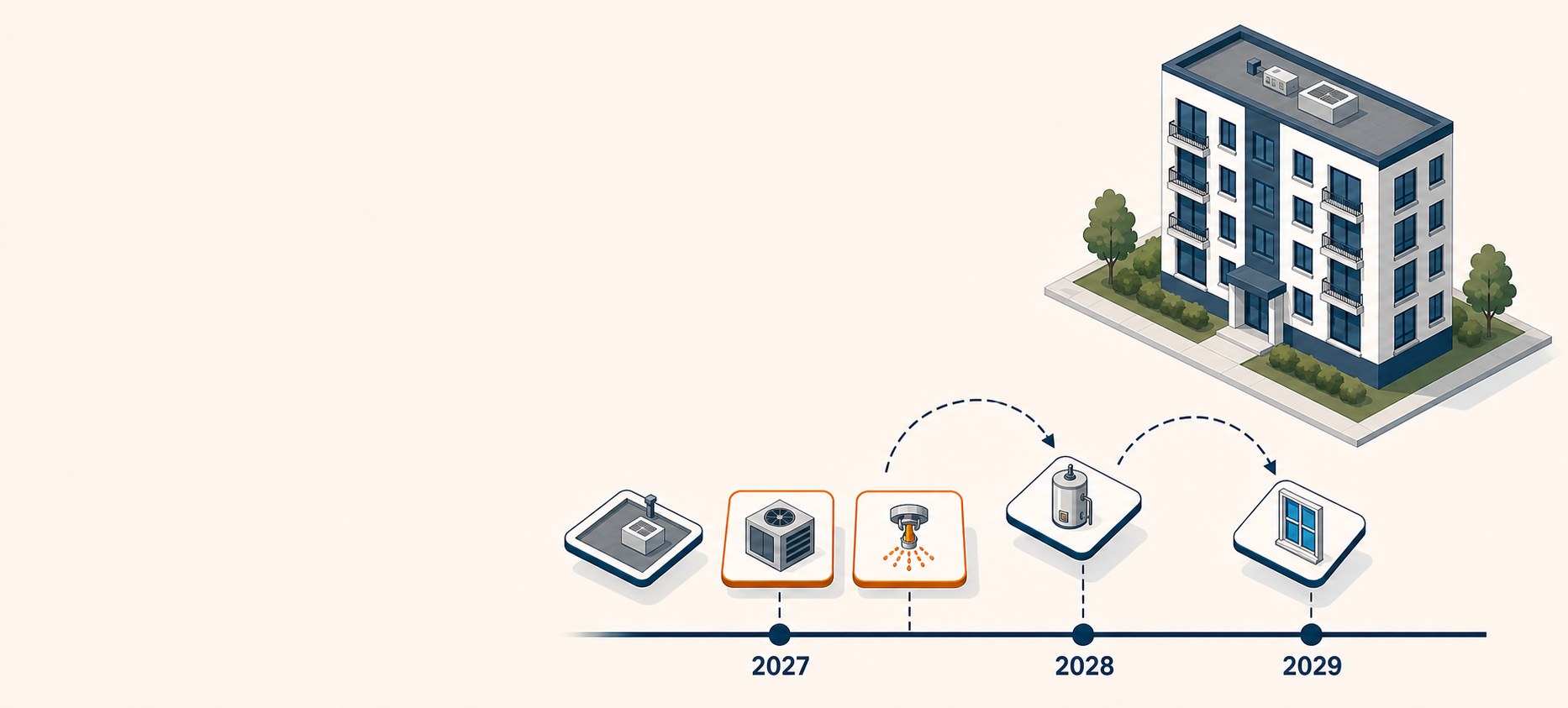
Re-sequencing means deciding what happens in 2027, what moves to 2028, and what waits for failure. It needs a budget built from individual assets and scopes. You can only reorder what you can see.
What a bottoms-up budget is built from
A bottoms-up budget starts from what's in each building and what condition it's in. Most owners have more of those inputs than they think, scattered across systems:
- Work-order history. The most direct signal of what's failing and how often.
- Quantities. Square footage, unit mix, roofing area, window and fixture counts, from as-built documentation where it exists.
- Inspection reports and property condition assessments (PCAs). Usually commissioned at acquisition or refinance, then filed away.
- Capital site-walk notes. Often the most current view, and often the least structured.
Pulling those together is the hard part. Tailorbird's 2027 CRE Trends Report, The Confidence Gap, found the average CapEx project runs across 5.1 separate systems. Half of the 306 CRE decision-makers surveyed (50%) named inaccurate or incomplete starting data as a driver of budget variance, ahead of market and cost volatility (43%).
One more step matters as much as the data: write down the assumptions. Expected life, replacement cost, failure frequency. When the committee asks why the roof is in 2027 and the clubhouse is in 2029, the answer should be in the budget, not in someone's memory.
A four-tier filter for what moves and what doesn't
Once the budget is built from assets and scopes, re-sequencing becomes a sorting exercise. A simple filter:
1. Life safety: fund it, don't move it. Fire and life safety systems such as sprinklers, stairs, structural items, anything with code or liability exposure. These aren't candidates for deferral at any budget level.
2. High failure, high resident impact: fund close to fully. Mechanical systems and anything with a high work-order frequency, especially habitability-adjacent systems residents notice right away: heat, hot water, cooling, water intrusion. Deferring these doesn't save money. It moves the cost to an emergency, usually at a higher price, and it shows up in renewals.
3. Low failure signal: replace on failure. Some components are standard to run until they break. If a light fixture fails, replace it. There's no reason to fund a planned program for items whose failure is cheap, contained, and quick to fix.
4. No resident impact: push it out. Plenty of line items can move a year or two without anyone noticing. Moving them should be a recorded decision with a date to revisit, not something that falls out of a spreadsheet.
Applied to a bottoms-up budget, this filter lets a team cut a plan substantially while protecting the scopes that carry real risk. Applied to a top-down budget, there's nothing to sort.
Rising costs make the ranking matter more
The same research found that 84% of CRE decision-makers are confident in their CapEx budgets at approval, yet 66% say completed projects exceed budget by more than 5%. And 91% revised or reversed a capital allocation in the past 24 months because their CapEx data was incomplete, delayed, or siloed.
Those numbers were gathered before September's price jump. With input costs moving faster, the gap between a budget built on assumptions and one built on the buildings gets more expensive. Every tier-2 system that slips to an emergency replacement gets bought at next year's price.
Where Tailorbird fits
Tailorbird doesn't replace your planning process. It gives the bottoms-up budget a verified foundation. Teams use Tailorbird to get as-built models and construction-grade quantities, 98% accurate with no site walk. They run bids from a shared scope and track committed and spent dollars against budget as the re-sequenced plan moves through the year.
The safe call isn't the one that feels safest
A uniform cut is easy to approve because it doesn't require anyone to know very much. That's why it disappoints. The overruns that hurt in 2027 won't come from the line items everyone understood. They'll come from the ones nobody could see.
The teams in the best position this cycle won't be the ones that spent the least. They'll be the ones that could show, line by line, which dollars had to move and which didn't.
Read the full findings in the 2027 CRE Trends Report, The Confidence Gap. tailorbird.com/2027-cre-report
Methodology: Censuswide survey of 306 U.S.-based CRE decision-makers and senior operators, fielded July 23 to August 6, 2026. Multi-response questions may total more than 100%. Price data: ABC, "Construction Materials Prices Jump 2.2% in September, Up 11.2% Year Over Year," Oct. 15, 2026.